Have you ever wondered what makes a psychology or inter-disciplinary team truly effective? It isn’t just about budgets or skills. It’s the values that guide how people work together. When a psychologist acts on healthy professional values, they can help others grow, contribute and influence the systems they work within. This can help to create a strong and positive working environment for everyone.
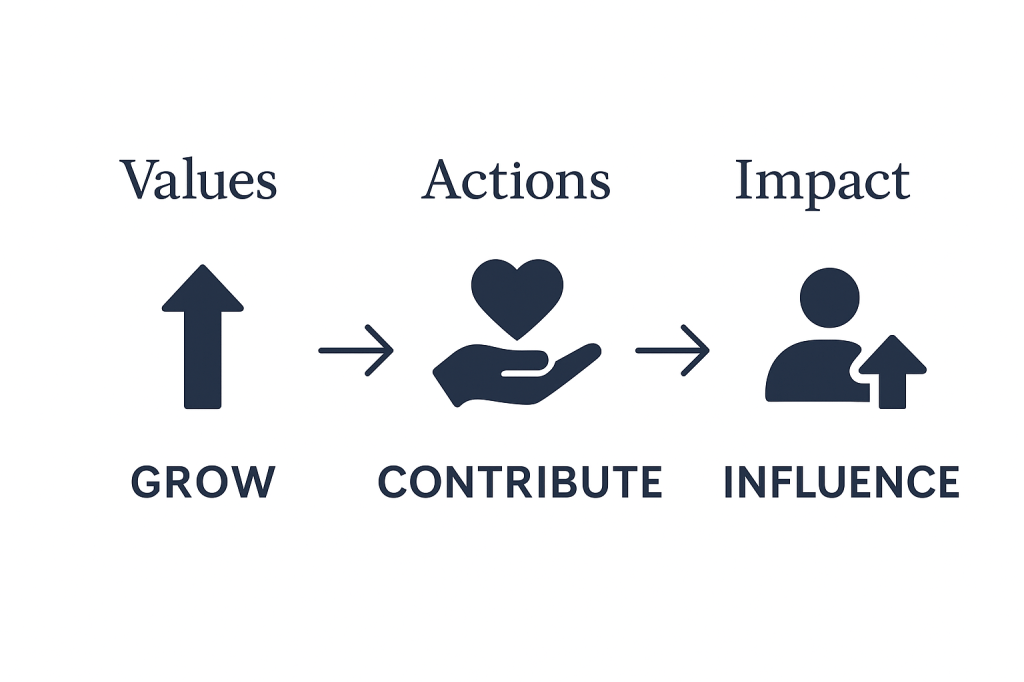
Grow: What Do You Value Most?
Professional growth lays the foundation for our work. But it requires clarity about what matters to us most.
The Valued Living Questionnaire (VLQ) is a tool that asks two simple questions: What matters to you most? And how closely do your actions reflect it? The questionnaire spans twelve life domains, including work, family and community, and asks us to rate both their importance and our consistency in living them out. A big gap between importance and consistency suggests an opportunity for change, rather than a sign of failure.
A good psychologist seeks new knowledge and skills. They don’t just wait for required training; they find fresh ways to help people. They see challenges as chances to learn, always aiming to improve their service.
Contribute: Aligning Action with Purpose
Clarity alone is not enough. Our contributions last when our actions reflect our values.
For example, a psychologist who values community might reallocate their time from paperwork to facilitating networking between colleagues. This builds a culture of support, leading to stronger teams and better care.
Good professionals put their team’s success first. They share knowledge freely and take on difficult cases. They ask, “How does this help our clients?” more than “What’s in it for me?”
Influence: Leading Through Values
Lasting influence comes from earned trust. Have you ever seen a colleague whose quiet competence causes everyone to listen? These professionals guide decisions with evidence and explain complex ideas simply.
Their impact spreads quietly through better outcomes and stronger teams. They shape culture by leading through consistent competence more than self-promotion. By navigating the boundaries of their work, they influence service design, shape local policy and strengthen professional autonomy.
Putting It Into Practice
I believe these three values – grow, contribute and influence – form the foundation of effective psychology practice. They create consistent purpose and direction for both professionals and their teams.
Here’s how these values can guide actions and outcomes in different sectors:
Summary of Sector-Specific Examples
| Sector | Focus | Impact | References |
| Local Authorities | Psychologists working in three Scottish services: Embedded, cyclical, triangulated, reflective evaluation | Learning, wellbeing, behaviour, reflection, national adoption. | Turner et al., 2010 |
| NHS | Psychologists working in physical healthcare: role fluidity, policy influence | Workforce growth, integration, leadership, upskilling, patient recovery | Bhutani et al., 2024 |
| Charities and cross sector | Psychologists working across contexts: ethics, standardisation, contextual adaptation, stakeholder-driven. | Recovery, improvement, ethical tension, cultural awareness. | Overington, 2020 |
Consider which of these values resonates with you most right now. How could you use them to guide your next action?
References
Bhutani, G., Jenkinson, E., Kalsy-Lillico, S., & Moore, E. (2024). A strategic approach to sustainable growth of the psychological professions’ workforce in physical healthcare. Clinical Psychology Forum. DOI:10.53841/bpscpf.2024.1.375.53
Overington, C. (2020). Organisational structural and situational contexts in counselling psychology. Counselling Psychology Review. DOI:10.53841/bpscpr.2020.35.1.61
Turner, S., Randall, L., & Mohammed, A. (2010). Doing an effective job? Measuring the impact of casework. Educational Psychology in Practice, 26(4), 313–329. https://doi.org/10.1080/02667363.2010.521306
 Laurie Petch
Thank you for sharing your welcome thoughts in a spirit of kindness: